
Decatur County Wanted Fugitives
A wanted-fugitive notice is a public-safety appeal. It is not a catalog of every warrant in Decatur County. Right now the county has no online name-search portal for warrants, and the Decatur County Sheriff's Office keeps no standing most-wanted page. So the answer is specific: no active wanted list appears on the official site. That gap says little about any one warrant. An empty search or a deleted social media post does not clear anyone.
Watch the sheriff's official website and Facebook presence instead. That is where a BOLO, a be-on-the-lookout request, tends to appear when investigators need help finding or identifying someone. Posts get updated once the person is found or taken into custody, and some vanish entirely. Check the date, the agency attribution, and the most recent status on the DCSO post itself. No wanted photo is reproduced here; the agency's own post is the source. Verification belongs with the sheriff's office, the court handling the case, and the latest docket entry. Never confront, follow, or detain anyone because of a notice you saw online.
What a Decatur County Notice Shows
Decatur County publishes no standardized wanted page. That means no fixed set of fields can be promised. One DCSO BOLO may look nothing like the next. The table below separates details an agency post typically documents from details that demand a fresh look at the active notice. A copied image or an old summary can never confirm that a warrant stands today.
| Notice element | What the official material may show |
|---|---|
| Agency identity | DCSO branding, an investigator, or an official social account identifies the source. |
| Person and image | An individual BOLO can include a name and a law-enforcement-supplied photo. DCSO's jail search itself says booking images are not available. |
| Alleged conduct or basis | The post may describe alleged conduct, a request to locate someone, or a warrant-related concern. The wording is not a court disposition. |
| Last-known details | A post can include a last-known area or other locating information. Such details can become stale quickly. |
| Contact route | An investigator, DCSO, the Anonymous Tips form, or an emergency instruction may be supplied in the active notice. |
| Safety direction | Official appeals can tell the public not to approach and to pass information to law enforcement instead. |
Never fill a blank field with a guess. A name match alone is weak evidence. Common names make it weaker. Compare the agency, the date, the physical description, the case language, and any newer update. If the post names no warrant number or court, ask the clerk or DCSO which office can confirm the record.
How to Read a Decatur County Notice
Reading an official appeal takes more care than scanning a face or a headline. Start with the source. The Decatur County Sheriff's Office website and its official Facebook page are the agency's own channels. A news story can point you toward a BOLO, but the agency post is the better place for the current warning and contact instructions.
- Open the DCSO website or official Facebook post and note the publication date, agency name, and any update.
- Read the text, not only the image. Record the alleged conduct, physical details, last-known information, and investigator contact if those items are supplied.
- Check whether the post says to call 911, use a specific investigator, or submit information through the DCSO Anonymous Tips form.
- If the notice concerns someone already booked, use the county booking path at Decatur County's official record search for the appropriate admit window. The jail search can show booking data, not a public booking photo.
- Before drawing a conclusion, compare the name and date with the court or clerk record. A booking, BOLO, or warrant charge does not establish guilt.
A public post is no substitute for direct confirmation. Someone named in a BOLO may already be held by another agency, released after booking, or tied to a case whose status has shifted. The county jail's Current Confinements view answers one narrow question: who is in the county jail right now. It cannot tell you whether a BOLO remains active or what the court has decided.
Decatur County Tips and Safety
DCSO's Anonymous Tips form routes information to the proper investigative unit and states that submissions are kept in strict confidence. It can collect incident details, a suspect description, vehicle information, weapons or narcotics details, and related facts. Leaving contact information is optional and may help investigators follow up. The agency promises confidentiality, but nothing more. Expect no reward and no technical guarantee beyond that wording.
DCSO tip and safety route
Send non-emergency information through the official Anonymous Tips form. If danger is immediate, call 911.
DCSO: 229-248-3044
Do not approach, follow, or attempt to detain a person named in a BOLO.
What the research found
No Crime Stoppers affiliation, public reward terms, Warrant Wednesday series, or recurring reward program turned up anywhere in the county. Note: do not promise anonymity beyond what the agency itself says about its form.
Use 911 for an immediate threat. For everything else, follow the contact route in the current official post or reach DCSO directly. Sending a tip is not a citizen's arrest. The safest move is simple: keep your distance, remember what you saw, and let trained officers decide on a response.
DCSO Facebook, Apps, and Victim Services
Skip the app store. Decatur County's sheriff office has no verified jail or alert app, and similarly named apps from other states just confuse people. The dependable route is Citizen Connect. It's a mobile-friendly web portal, not an official county application, and it carries current jail confinements plus recent admits.
Facebook is a supplement, nothing more. The DCSO account posts agency news and BOLOs, but booking photos and wanted notices appear on no set schedule. Any post can vanish or go stale after an arrest. For a real status answer, call the agency or the court. Treat the feed as a bulletin board, not a ledger.
Victim Services offers victims free, confidential help and case updates through Chief Deputy Wendell Cofer at 229-248-3044. That line serves victims, not the public. It won't chase release dates for curious callers. The county has no documented VINE signup or jail-alert subscription, so don't count on automatic notifications.
Wanted List vs Decatur County Warrant
A warrant and a wanted notice are different animals. The warrant is a court order. It can authorize an arrest or summon someone before a judge. A BOLO is a selective public plea for help finding a person. One can exist without the other. An active warrant may never appear on a wanted list, and a BOLO can circulate while the underlying warrant record stays unpublished. The official DCSO site offers no public warrant search by name, so none of this can be confirmed from a keyboard.
| Question | Wanted notice | Warrant check |
|---|---|---|
| Purpose | Public help with a selected location or safety matter. | Confirm a case-linked court process for an identifiable person. |
| Scope | Selective and dependent on an agency decision to publish. | Handled through the court, clerk, or DCSO contact that can verify the record. |
| Photo | An individual BOLO may carry a supplied photo. | A warrant check does not mean a booking photo will be released. |
| Status | Can become stale after location, arrest, recall, or correction. | Must be confirmed with the responsible office because custody and court status change. |
| Safe response | Send a tip. Do not approach or detain. | Use counsel, the court, the clerk, or DCSO to resolve the question. |
An empty post means nothing. Silence on a public page is not proof that someone is clear; it just means you need a different route. For anything tied to a specific person or case, contact the Magistrate Court, the Clerk, or DCSO directly using the details below.
How to Check a Decatur Warrant
There is no online name search here. Decatur County warrant questions run through phones and courts. Magistrate Court handles warrants and first appearances. The Clerk's office is your stop for dockets and court records. DCSO can speak to the custody side of things, though calling the jail will never turn the inmate portal into a warrant database. Pick the office that matches your question.
- Gather the person's full name and any known case number, court, arrest date, or identifying detail. A name alone can produce a mistaken match.
- Contact Decatur Magistrate Court at 912 Spring Creek Road, Box 3, Bainbridge, GA, 229-248-3014, for the court function that handles warrant and first-appearance matters.
- Contact the Clerk of Superior and State Court at 229-248-3025 for a case-linked docket or disposition question. Ask which court holds the record if the case is not in the expected division.
- Call the Decatur County Sheriff's Office at 229-248-3044 when the question concerns DCSO custody, service, or an agency notice. For current jail custody or bond information, the jail line is 229-248-3050.
- If the question may concern the caller personally, speak with an attorney before going to a courthouse or law-enforcement office. Counsel can explain a lawful court response, including surrender when appropriate.
Don't get clever. Never send a friend to test a warrant by walking up to an officer. Never dodge service by hiding, moving around, or confronting an alleged victim. Warrant questions get resolved in court, with counsel, not through evasion. And if a BOLO asks the public for tips, that is a phone-call duty, not a license for private detention.
Warrant Types and Next Steps
"Warrant" covers a lot of ground. What matters is the specific court, the case number, and the reason behind the paper. The comparison below is a plain-language starting point only. For a real answer, go to the Decatur court or a lawyer.
| Type | Plain meaning | Where to verify |
|---|---|---|
| Arrest warrant | A court-authorized process connected to an alleged offense and a request to take a person into custody. | Magistrate Court, DCSO, or the court and case identified by the records custodian. |
| Bench warrant | A court order commonly tied to a missed court appearance or failure to follow a court requirement. | The court clerk or court division handling the case. |
| Case-linked court process | A record may use a different local label or include more than one process in the same case. | Ask the clerk to identify the court, case number, and current status. |
A warrant entry marks a beginning, not an end. The docket tells the rest of the story: service, recall, dismissal, a plea, or a trial. The jail portal may show a booking once the warrant is served. That booking is where the court process starts. The docket is where it finishes.
Decatur County Court Disposition
The court record outlasts every public notice. Superior Court takes the felony cases. State Court covers qualifying misdemeanors and traffic matters, while Magistrate Court handles warrants, preliminary processes, and certain first-stage proceedings. City ordinance and traffic cases land in Bainbridge Municipal Court. Which clerk and docket you need depends on the charge and the court that took the case.
Begin with the Decatur County Clerk of Superior Court, matching the person's name to a case number and county. The Georgia Courts E-Access directory and ResearchGA can point you toward participating court records, though digital coverage varies. Read the newest docket entry for the outcome. A booking field, a BOLO, or a news story never closes a case.
Federal Custody Is Separate
Someone named in a Decatur County notice can end up in entirely different hands. The Bureau of Prisons inmate locator tracks federal imprisonment and returns identifying and status fields, but no booking photo. Its records reach back to a stated 1982 range. Keep in mind that "not in BOP custody" proves nothing about freedom or about prior holds by a county, state, or immigration authority.
The ICE Online Detainee Locator is its own separate system for qualifying ICE or CBP detention. An A-number search needs exactly nine digits, padded with leading zeros, plus a country of birth. Some detainees are excluded, and new entries can lag. The sheriff's quarterly immigration reports are aggregate compliance paperwork, not a way to find a named person in ICE custody.
Then there is the U.S. Marshals Service Southern District of Georgia, which can arrest or transport federal fugitives but publishes no prisoner roster or mugshot gallery. For anything federal, rely on an official district notice or a federal court record; press releases and wanted posters are selective by design.
A screen capture of the BOP inmate locator shows what this separate federal channel looks like and what its status-focused search returns.
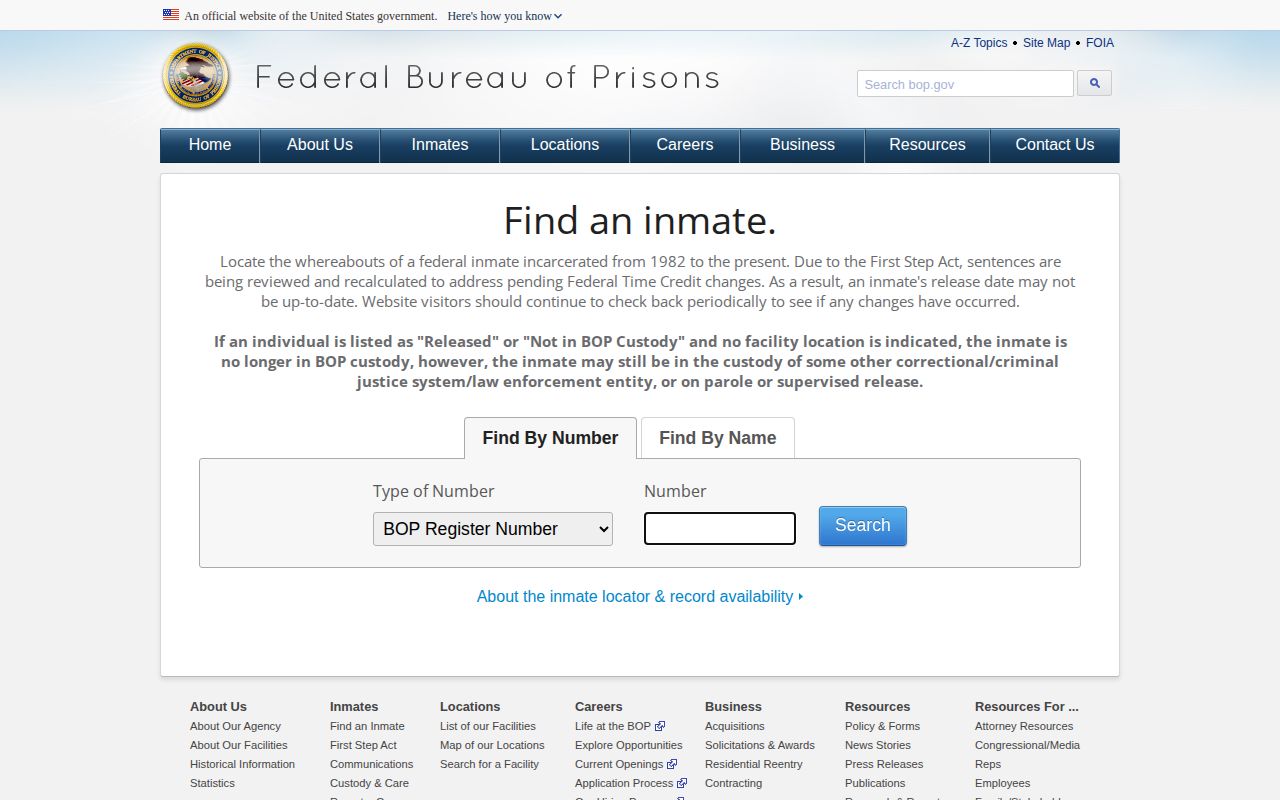
That picture has nothing to do with the DCSO wanted list. No one shown is a Decatur County resident. So why does it appear at all? It illustrates a real problem: federal custody records live in their own system. County warrants, jail admissions, and local BOLO alerts never automatically reflect them. Keeping those files apart prevents the most common mix-up in fugitive searches.
Unofficial Archive, Not a Wanted List
Third-party archives can lead you to a name or a news item. They cannot replace DCSO or the courts. The Decatur County archive from The Georgia Gazette pulls records through the Georgia Open Records Act. It may carry booking or crime posts. Its copy can lag or keep an old claim. It may also skip a later outcome entirely. So it is not a DCSO wanted list, a warrant database, or proof anyone sits in custody. The archive capture below documents the unofficial Decatur County section from The Georgia Gazette. Use it as a research aid, not an agency notice. And note that a photo there says nothing about the jail's no-image policy.
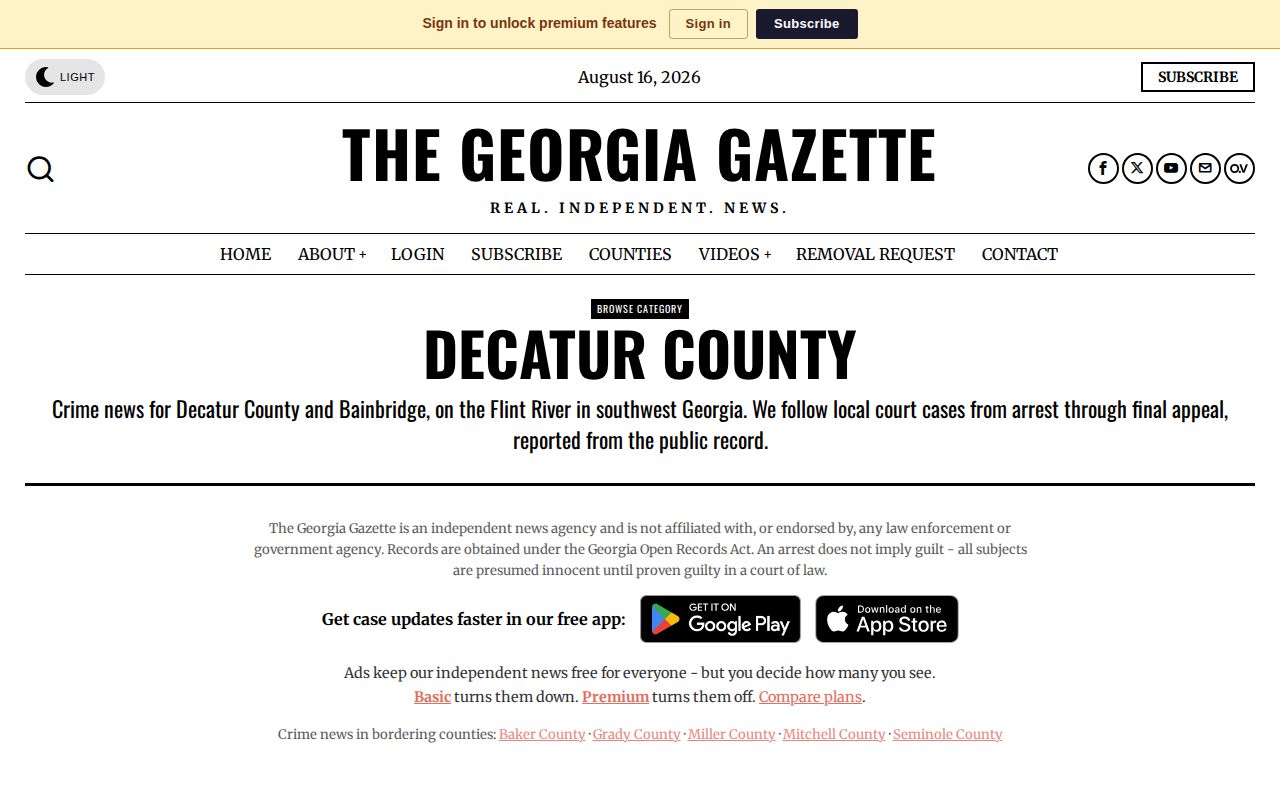
Go to the source that matches your question. Current custody? Use the Decatur County Jail search and call the jail when timing matters. A warrant? Use the court and DCSO contacts. A final outcome? Read the clerk's docket. Each route keeps the lines clear between a public appeal, a booking event, a court process, and a disposition.